Mirrabooka increases dividend in volatile year for small caps
Quick read:
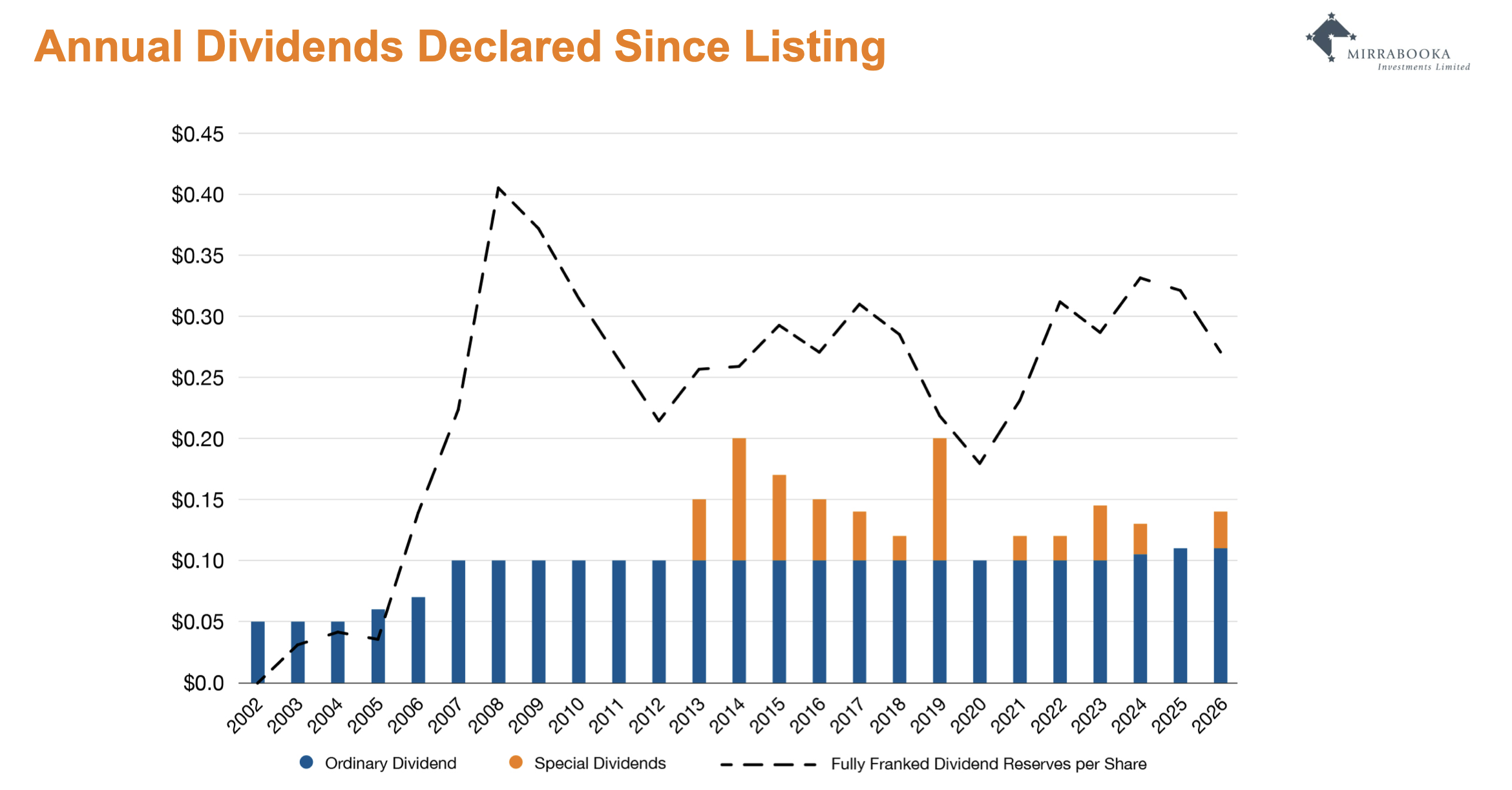
Total dividends of 14.0 cents per share fully franked, up from 11.0 cents in the prior year, including a special dividend of 3.0 cents per share
Net profit up on the prior year, with the special dividend sourced from realised capital gains; Mirrabooka has now paid 57 cents of fully franked special dividends since 2013
Portfolio return of -10.8% for the 12 months, against a benchmark return of 7.8%
Underperformance primarily driven by strong gains in mining stocks where Mirrabooka has limited exposure
Core investment philosophy remains unchanged, with ongoing refinements to the portfolio in accordance with Mirrabooka's investment framework
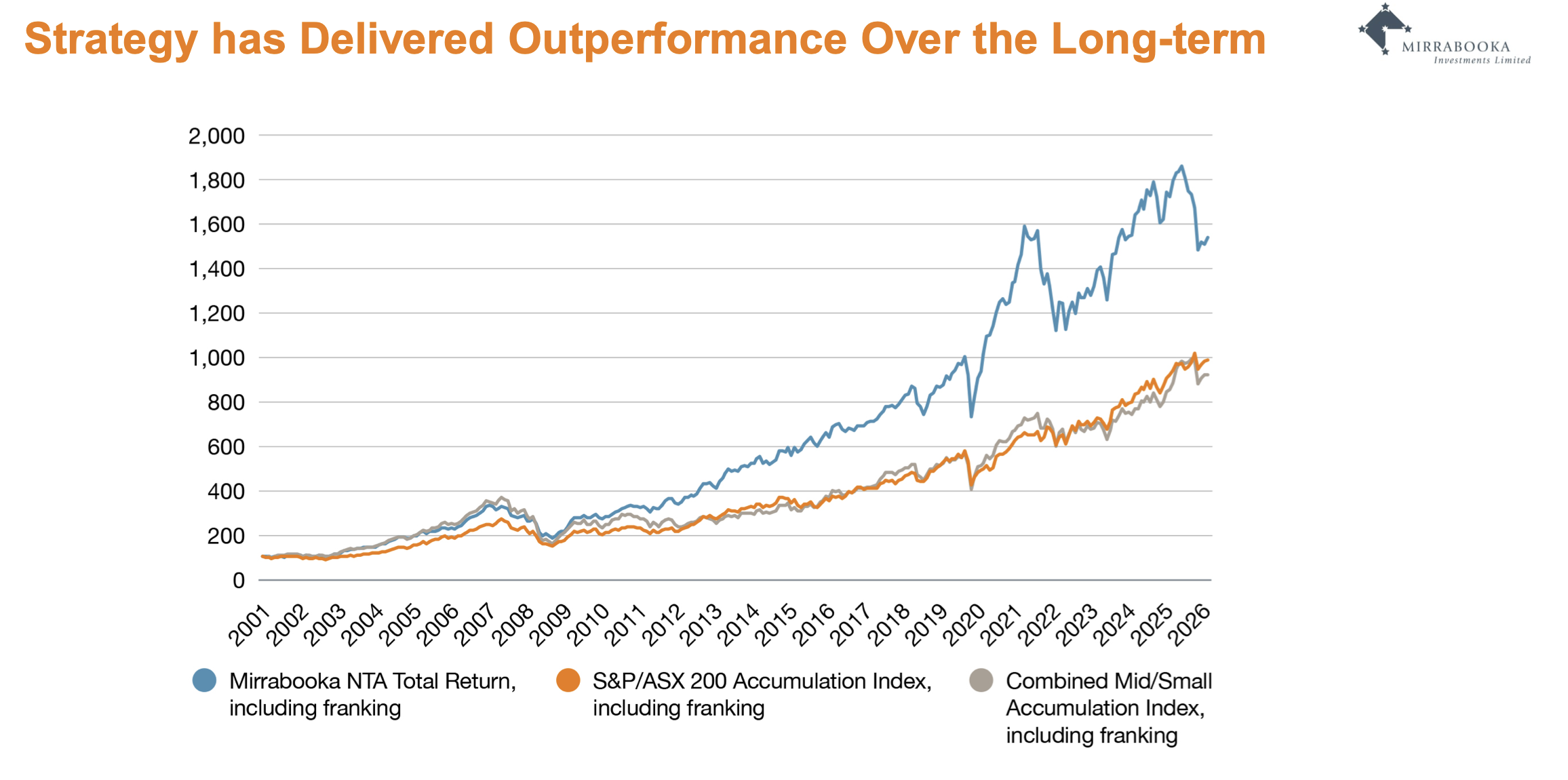
Long term track record intact, with outperformance of more than 3% per annum since inception 27 years ago
Mirrabooka increased its fully franked annual dividend to 14.0 cents per share, up from 11.0 cents, including a special dividend of 3.0 cents per share. Net profit rose to $13.0m, up from $7.0m in FY25, despite a portfolio return of -10.8% against a benchmark return of 7.8%.
Portfolio Manager Kieran Kennedy said the special dividend reflects the structural characteristics of investing at the small and mid-cap end of the market, where higher volatility drives greater portfolio turnover and, in turn, realised gains.
"That area of the market has more volatility than the larger end of the market, which leads to more turnover in the portfolio, and realised gains being a great feature in the returns that we generate for shareholders over time," Kieran said.
"We're conscious that those franking credits that we generate, as we pay the tax, have value in the hands of shareholders, not on our balance sheet, so we're keen to pay them out when we generate them," Kieran said.
Performance and positioning
The portfolio returned -10.8% for the year, compared with a benchmark return of 7.8% from the S&P/ASX Mid Cap 50 and Small Ordinaries Accumulation index.
Kieran pointed to three key drivers for the relative underperformance: the first was what Mirrabooka does not own - particularly in resources. Mid-cap resources rose 68% and small cap resources 31%, providing a highly concentrated source of market returns. While Mirabooka invests in resource companies, the portfolio tends to have limited exposure to this part of the market.
Small and mid-cap resources companies “tend to be very cyclical, and their fortunes are really dictated to by a commodity price they don't control, and they typically don't have the strength of competitive position that we see in the majors," Kieran said.
The second driver was a valuation de-rating in some holdings, often where the investment fundamentals of those holdings haven’t changed. Car Group, one of the portfolio's largest positions, was the clearest example - consistent, strong results, but a share price affected by market concerns around AI disruption.
Mirrabooka is monitoring the impact of AI closely, but holds the view that the strong fundamentals behind Car Group’s business model remain in place. Several other holdings have de-rated for similar perception-driven reasons.
The third was earnings downgrades in a small number of larger positions, including ARB and Temple & Webster. Both continue to be backed for the long term, but a soft consumer environment has slowed sales, and downgrades now have a materially greater impact on share prices than in the past. Positions where conviction was lost have been exited.
Balancing this, several holdings acquired in recent years performed strongly, including Channel Infrastructure. Kieran said these outperformers give confidence that the approach continues to work, and the task is to find more of them.
Refining the approach
Mirrabooka's core philosophy — to invest for the long-term in businesses that meet its criteria for quality — is unchanged, and has delivered outperformance of more than 3% per annum since inception.
What has changed, in Mirrabooka's assessment, is the market structure. Growth in passive money and short-term trading strategies focused on index weightings and near-term momentum has widened the dispersion of share price outcomes in both directions.
"When a business is under pressure, share prices can fall a lot further than they used to, and equally when a business is doing well, they can run a lot harder than they used to," Kieran said.
In such an investing environment, near-term setbacks in good quality businesses can often create opportunities to build positions at better entry points. Mirrabooka has also revised its view of the microcap end of the market, where reduced investor participation has lifted the cost of capital and made it harder for smaller companies to emerge. Selected microcap opportunities will now be monitored for longer before entering the portfolio.
Looking ahead
While near-term forecasting is not Mirrabooka's focus, Keiran highlighted several external macroeconomic risk variables including US government policy, conflict in the Middle East and a sluggish domestic economy.
Two features of the portfolio, however, offer encouragement. Valuations across a number of holdings are coming off a lower base, which should allow earnings growth to translate more cleanly into shareholder returns over the medium to long term. And sectors currently most out of favour — notably healthcare and technology — are industries where Mirrabooka can apply its long-term quality-focused approach to generate returns.
"If we continue to focus on quality companies and continue to monitor that and look for opportunities, it does set us up well for returns for the medium to long term," Kieran concluded.
The team looks forward to meeting with investors and stakeholders at the 2026 Annual General Meeting, which will be held on Monday, 5 October 2026.